The Visibility Concentration Effect: Why Half the Web Isn’t Qualified Anymore
Karamchand - Dec 25, 2025

AI search concentrates visibility among a small group of widely referenced brands. Data from 75,000 brands shows a sharp divide: without qualified third-party mentions, even well-optimized sites struggle to appear in AI-generated answers.
The mechanics of digital discovery are changing. A study of AI Visibility reveals that AI search operates on a winner-takes-all model, where visibility depends less on a brand’s own domain and more on whether the rest of the web is discussing it.
The data shows a sharp dividing line. Brands in the top 25% for web mentions average 169 appearances in AI Overviews, while those in the next quartile drop to just 14 mentions. Below the 50th percentile, brands average between zero and three mentions.
This isn’t a gentle slope. It’s a highly concentrated distribution.
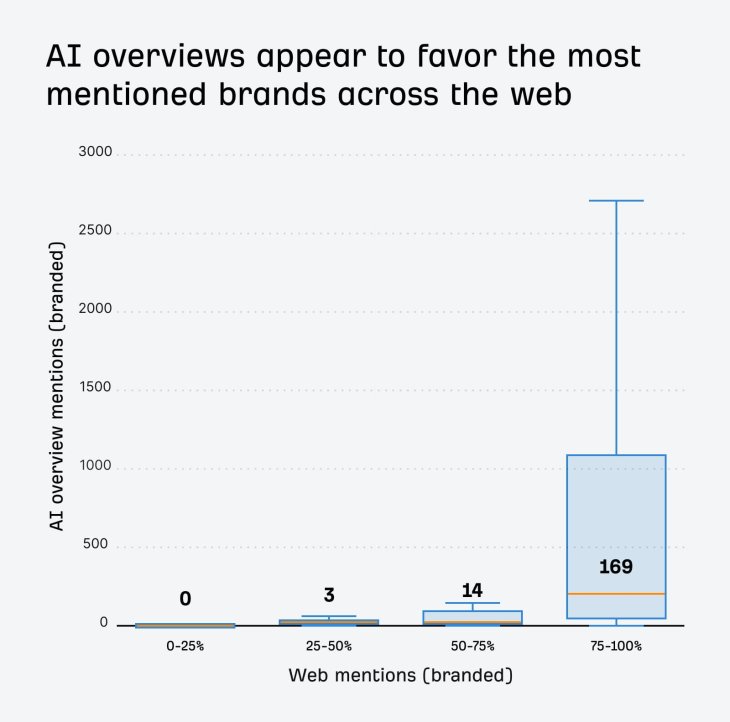
Why Traditional Metrics Don't Predict AI Visibility
The shift from Search Engine Optimization to Answer Engine Optimization represents a fundamental change in how authority is surfaced. The study found that branded web mentions correlate with AI visibility at 0.664, while traditional backlink counts show a much weaker correlation at 0.218.
The data suggests that conversational authority across the broader web may be more closely associated with AI visibility than domain-level authority alone.
Large Language Models are predictive systems trained on large web text corpora and appear to form associations between brands and topics through recurring patterns of word co-occurrence. Rather than evaluating a site in isolation, AI systems synthesize how third-party sources reference a brand across many contexts.
The Industry Whisper Network
AI visibility increasingly resembles an industry whisper network rather than a formal credentialing process. In traditional SEO, success often meant strong on-site signals combined with enough backlinks to be noticed.
In AI-mediated search, reputation emerges from distributed consensus. If five authoritative sites mention your brand as the solution to a problem, the AI will recommend you even without direct links. When no such discussion exists, even well-optimized sites may fail to surface.
This may help explain why roughly 26% of brands in the study recorded zero AI Overview mentions, despite meeting baseline domain authority thresholds.
Strategic Implications
The data suggests four priorities for brands navigating this visibility concentration effect:
1. Digital PR over technical optimization
Securing mentions on high-authority pages shows a strong correlation (approximately 0.70) with AI Overview appearances within this dataset. This does not guarantee inclusion, but it indicates a relationship worth prioritizing.
2. User-generated platforms matter disproportionately
Domains such as YouTube and Reddit appear frequently in AI-generated responses. Active discussions on these platforms may play a larger role in AI visibility than traditional SEO frameworks previously assumed.
3. Topic selection drives mention frequency
The findings suggest focusing on topics where a brand becomes difficult to exclude from the conversation. When a brand is repeatedly referenced in relation to a problem space, those associations may reinforce AI visibility.
4. Linked mentions with brand-rich anchors remain relevant
While unlinked mentions account for much of the correlation, branded anchor text still shows a meaningful relationship (0.527) with AI visibility. This suggests a hybrid model where both linked and unlinked mentions contribute to overall presence.
Reinforcing Visibility Dynamics
The winner-takes-all distribution creates reinforcing dynamics within AI search. Visibility breeds more visibility. Brands already present in the web’s broader conversation are more likely to be referenced again, while those outside it remain largely invisible.
Breaking into this pattern may require concentrated efforts to generate third-party mentions across authoritative sources, rather than incremental improvements to owned properties alone.
What This Means
We are witnessing a transition from technical optimization to reputation formation as a primary factor in digital discovery. In the SEO era, visibility could often be won through structural and on-site improvements. In the AEO era, visibility increasingly reflects how a brand is discussed when it is not speaking for itself.
While the long-term dynamics are still emerging, the data suggests that treating AI visibility solely as a technical SEO problem risks overlooking how modern discovery systems synthesize authority.
The visibility concentration effect is measurable. Brands that fail to establish qualified presence across the wider web are increasingly likely to remain unseen in AI-generated answers.
Featured Stories

How To - Mar 04, 2026
Getting Started with AI: A Newbie's Simple Guide
ICT News - Mar 03, 2026
Budget Entry-Level PCs Under $500 to Vanish by 2028 Due to Memory Price Surge

ICT News - Mar 02, 2026
IDC Report Predicts Surging Smartphone Prices Due to Global RAM Shortage
ICT News - Mar 01, 2026
Samsung Links Galaxy S26 Price Hikes to AI Memory Supply Issues

ICT News - Feb 28, 2026
Anthropic Blacklisted by US Department of War: Trump Orders Federal Ban Over AI...

ICT News - Feb 26, 2026
AI Models Frequently Resort to Nuclear Escalation in Simulated Crises, Study...

ICT News - Feb 23, 2026
It's Over for Xbox: Asha Sharma Takes Over to Ruin Microsoft Gaming with AI

ICT News - Feb 22, 2026
Which AI Model Excels at Which Task in 2026: A Comprehensive Guide

ICT News - Feb 21, 2026
AI Coding Agent Causes Major AWS Outage at Amazon

ICT News - Feb 20, 2026
Tech Leaders Question AI Agents' Value: Human Labor Remains More Affordable
Read more
ICT News- Mar 02, 2026
IDC Report Predicts Surging Smartphone Prices Due to Global RAM Shortage
This development underscores the broader ripple effects of the AI boom on everyday technology, highlighting the interconnected nature of global semiconductor supply chains.
ICT News- Mar 03, 2026
Budget Entry-Level PCs Under $500 to Vanish by 2028 Due to Memory Price Surge
The era of the sub-$500 PC appears to be ending.
How To- Mar 04, 2026
Getting Started with AI: A Newbie's Simple Guide
Are you curious about artificial intelligence but not sure where to begin? You are not alone.
Comments
Sort by Newest | Popular