Indian E-Commerce Industry To Hit $230 Billion By 2028
Sundar Pichai - Sep 19, 2019

The Indian e-commerce market size is likely to reach $230 billion in a decade as it's outpacing the offline retail segment's growth.
- Delhi Is The World’s Most Polluted Capital City For Three Years In A Row
- Indian Farmers Install High-Tech, Night-Vision CCTV Cameras To Protect Themselves
- Looking For The Best Electric Bike In India 2021? Take A Look At These
According to a recent report by the E-Commerce Council of India (TECI), the Indian electronic commerce market is likely to generate total revenues of $230 billion within the next decade. The industry’s growth rate has been outreaching the number of the offline retail segment, ranked as the highest across the world. This upswing is supposed to be facilitated by the increasing acceptance of smartphones, the expansion of Internet usage, as well as the low data tariffs.

It is estimated that 10 crore people in India are shopping online. By 2028, around 40-50 crore consumers will be added to the whole ecosystem, giving birth to the next hundred-billion-dollar industry.
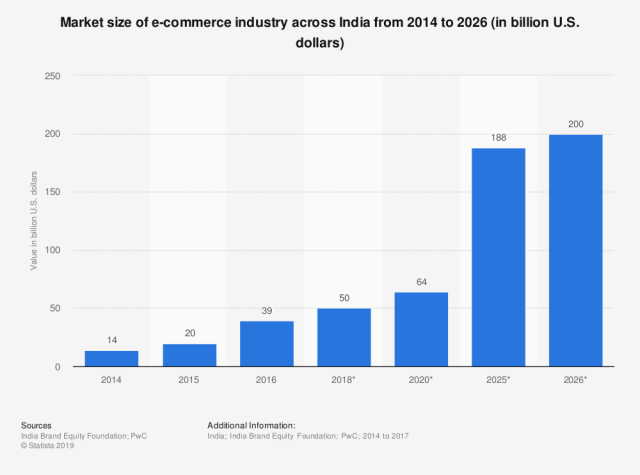
Indian e-commerce market: threats and potentials
The development of broadband, additional services, and facilities within e-commerce platforms will help sellers to attract more consumers from semi-urban and rural areas. Contemporarily, urban shoppers, particularly from Tier-I cities, are accounting for the largest proportion within the user base.

The report said nearly 90% of the survey respondents considered neutrality as the primary factor contributing to the success of the e-commerce industry. That means a platform must behave independently as the marketplace instead of running its own units or related parties within the site. For sellers, stores sponsored by the marketplaces attain more advantages over the independent ones and even damage their businesses.

Also, 90% of vendors said the fact that marketplaces operate private labels on their platforms would create a conflict of interest between parties. Sellers believed that customer insights extracted from the platforms’ data would give their private labels an unfair advantage and a better opportunity to create appropriate pricing policies.
Featured Stories

ICT News - Sep 19, 2026
Washington Acknowledges Operational Weapons in Earth Orbit

ICT News - Aug 04, 2026
Telegram Vanishes from Apple App Store Worldwide

ICT News - Jul 31, 2026
Russian Buyer Finds Water Bottle in $1,125 Graphics Card Box

ICT News - Jul 29, 2026
The RAM Crisis: Graphics cards shoot up in prices again

ICT News - Jun 27, 2026
OpenAI Launches Limited GPT-5.6 Preview Amid U.S. Security Review

ICT News - Jun 16, 2026
Elon Musk Becomes World's First Trillionaire After SpaceX's Record IPO

ICT News - Jun 14, 2026
The Technological Revolution at the 2026 FIFA World Cup

ICT News - Jun 03, 2026
Apple's Liquid Metal Hinge Poised to Deliver Breakthrough for Foldable iPhone...

ICT News - May 29, 2026
New Glenn Rocket Explodes in Massive Fireball During Static Fire Test at Cape...

Mobile - May 24, 2026
Comments
Sort by Newest | Popular