Two Japanese Exploratory Robots Might Just Successfully Land On An Asteroid
Indira Datta
Two exploratory robots of Japan might just successfully land on an asteroid.
- The First Space Hotel In The World Will Welcome 400 Guests
- Startup Builds Vehicle With Soviets Tech To Collect Space Garbage
- World's First Space Hotel To Begin Construction In 2025 With Rooms For 400 Guests
LANDING ON ASTEROIDS
A pair of robots named Bruce Willis has a mission aiming to shed light on the solar system's origins. The rovers have landed on an asteroid whose distance from the Earth is millions of miles and begun a survey. Those robots, unlike Willis, are not sent there to blow it up. These bots are sent there to serve the purpose of studying the kilometer-wide space rock, and each bot has a weight of 1.1 kilograms (2.4 pounds).
We are still not sure whether they will succeed or not, but as we can see this is an actual impediment. Until Saturday, we can be sure that they survived the touchdown. Yuichi Tsuda – challenge supervisor on the Japanese House based on Phys.org said that they have had lots of hope. They could not confirm anything yet but they were very optimistic.
A rendering image of the two robots on the surface of Ryugu
BOUNCE BOTS
The Japan Aerospace Exploration Company launched in December 2014 is Hayabasa2 – a spacecraft with the size of a refrigerator was destined for Ryugu – a lumpy asteroid about 289 million kilometers from the Earth. In June, Hayahusa2 reached Ryugu; and on Friday, he tossed two little exploratory robots toward the asteroid.
In the case that they successfully manage to land, those two robots will then use their motors which is powered by solar energy to bounce around the surface of the asteroid, remaining airborne for periods around 15 minutes due to the weak gravity of Ryugu. The bots will record information such as photos of the asteroid as well as surface temperature from a vantage point up to 15 meters above the surface and then send it back to Earth.
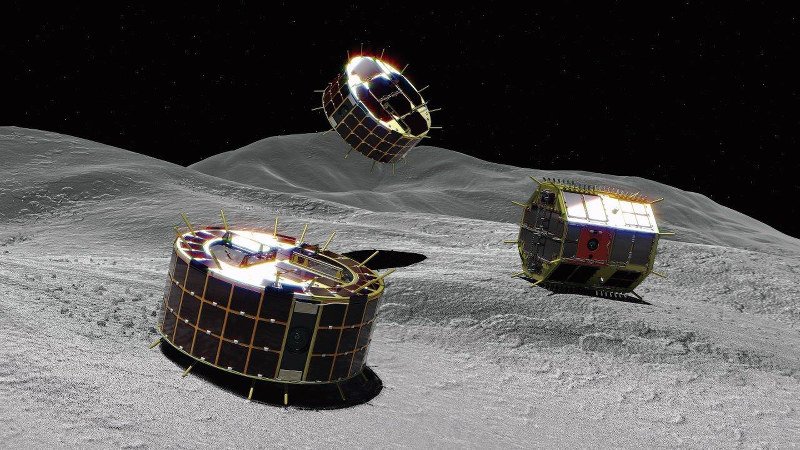
A rendering image of the two robots on the surface of Ryugu
BACK HOME
As Ryugu and similar asteroids have not had many changes over the past 4.5 billion years, this mission could assist us in understanding more about how our solar system was formed. It could also help provide useful information for future asteroid mining efforts. Besides, there is a big financial incentive for figuring out what are the best ways to harvest those potential profits because this Ryugu is worth an estimate of $95 billion.
Hayabusa2 will probably hang around Ryugu until the end of 2019 to complete some other experiments. It is expected to return to the Earth by 2020 with some samples — and hopefully, those sample will give us more insightful information into our past as well as our future.
Featured Stories
ICT News - Sep 19, 2026
Washington Acknowledges Operational Weapons in Earth Orbit
ICT News - Aug 04, 2026
Telegram Vanishes from Apple App Store Worldwide
ICT News - Jul 31, 2026
Russian Buyer Finds Water Bottle in $1,125 Graphics Card Box
ICT News - Jul 29, 2026
The RAM Crisis: Graphics cards shoot up in prices again
ICT News - Jun 27, 2026
OpenAI Launches Limited GPT-5.6 Preview Amid U.S. Security Review
ICT News - Jun 16, 2026
Elon Musk Becomes World's First Trillionaire After SpaceX's Record IPO
ICT News - Jun 14, 2026
The Technological Revolution at the 2026 FIFA World Cup
ICT News - Jun 03, 2026
Apple's Liquid Metal Hinge Poised to Deliver Breakthrough for Foldable iPhone...
ICT News - May 29, 2026
New Glenn Rocket Explodes in Massive Fireball During Static Fire Test at Cape...
Mobile - May 24, 2026