Facebook Announced 3D Photos Feature, Uses AI To Simulate Photo’s Depth
Author - Oct 13, 2018

Facebook just announced a new feature called 3D photo that allow users to take and post 3D photos to their Newsfeed.
- Billion Dollar Blunder: Meta Shuts Down Metaverse After Wasting $80,000,000,000.00
- Instagram Launches A Lite Version For Users In Rural And Remote Areas
- Australia Passed New Law That Requires Facebook And Google To Pay For News Content
Facebook just released a feature called 3D photos. It allows users to post images with 3D effects to their Newsfeed. The feature was introduced at F8 conference of Facebook in May 2018, but Facebook had not gone into details how the feature would work up until now. They have just released further details of the 3D photo feature that gives us a good idea about how AI (Artificial Intelligence) is utilized to simulate the depth in a typical 2D picture.
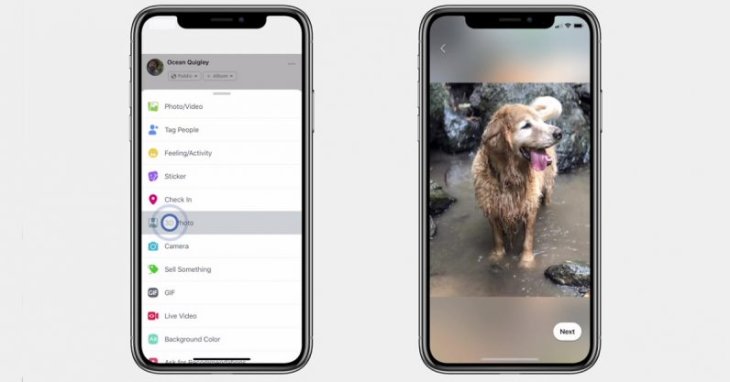
This 3D photo feature will work with photos in portrait mode and those 3D photos will be visible to both PC and mobile users and also VR with Oculus Rift or Oculus Go. You can simply click or tap on the photo and then drag to move it in order to see it in 3D.
Behind the screen
Both cameras will be used in a dual set up in portrait mode. One camera is used to capture the depth perception in order to create an effect called ‘bokeh’. However, for 3D photo feature of Facebook, AI will use parallax differences, which is ‘how an at different distances shift different amounts when the viewing angle is changed’ to simulate what is behind the object.
The designers of this system are Peter Hedman from University College London and a research scientist named Johannes Kopf Computational Photography research group of Facebook. You normally have to move your cameras if you want to capture photos like that. However, with the popular presence of dual cameras, measuring the difference in parallax between two lenses is much easier. It just put a bit more work on the CPU.
The number crunching
To capture a photo in portrait mode, each camera will both take a photo and then the phone will proceed to calculate a depth map between two taken images. The phone basically calculates the distance of every object in the photo’s frame. Smartphones of Samsung, Huawei or Apple, that feature is often used to make blur effects in the photo’s background.
The system of Facebook, users will have to move the camera around where they want to take the photo and take multiple images. The depth maps between the two for each taken image will then be analyzed by a custom algorithm and it also analyzes how much the cameras have shifted in each time. They will then be combined together and turn your 2D images you took into 3D photos that have movement and depth when users tilt their smartphone or view inside a VR headset

This feature is now only limited to users of iPhone 7 Plus, iPhone 8 Plus, iPhone X and iPhone XS but Facebook will provide this feature to a wide range of devices in the future.
Featured Stories

ICT News - Jun 27, 2026
OpenAI Launches Limited GPT-5.6 Preview Amid U.S. Security Review

ICT News - Jun 16, 2026
Elon Musk Becomes World's First Trillionaire After SpaceX's Record IPO

ICT News - Jun 14, 2026
The Technological Revolution at the 2026 FIFA World Cup
ICT News - Jun 03, 2026
Apple's Liquid Metal Hinge Poised to Deliver Breakthrough for Foldable iPhone...

ICT News - May 29, 2026
New Glenn Rocket Explodes in Massive Fireball During Static Fire Test at Cape...

Mobile - May 24, 2026
iOS 27 Preview: Apple Delivers Its Most Intelligent Siri Yet Alongside Fresh AI...

ICT News - May 08, 2026
Elon Musk Highlights Neuralink Breakthrough with New Surgical Robot for Brain...

ICT News - Apr 13, 2026
DDR4 RAM Prices Finally Fall After Soaring More Than 2,200 Percent

ICT News - Apr 06, 2026
Artemis II Crew Enters Moon's Gravitational Sphere on Historic Day 5

ICT News - Mar 31, 2026
Comments
Sort by Newest | Popular