Sensor System Riding on Bumblebees’ Back to Collect Environmental Data
Anita - Dec 16, 2018
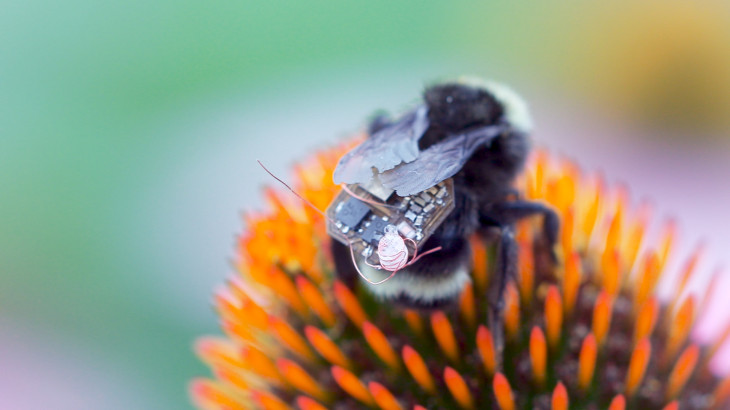
University of Washington’s scientists has introduced a new sensor system that rides on the backs of bumblebees in order to gather the data of their environment.
- This App Lets You Know Who Is Stalking You
- IoT Threats Are Considered Top Security Risk By 21% IT Managers in India
- AI-Driven Tech To Create More Than 28 Lakh Jobs In Indian Rural Areas
Bumblebees now can be used to collect the environmental data thanks to the Living IoT system riding on their backs.
In particular, scientists of the Paul G. Allen School, University of Washington have just released a new study on the invention of a sensing system without wire which is small enough to ride on the back of a bumblebee.
This idea is called the Living Internet of Things (IoT) system. And it is aimed to reasonably replace the manmade drones which are being used to research in the agricultural sector and monitor the environment to collect the weather, light intensity, and humidity data.
Bees with this newly invented system on their back can fly for seven hours to collect the data without the need for recharging battery like manmade drones.
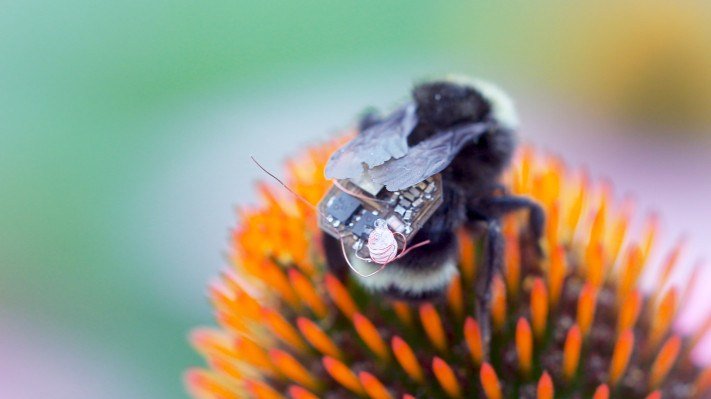
Bumblebees with sensor package to collect environmental data
The tiny package requires only a small amount of power for computation. And the system records the different positions of the insect in two-dimensional space when it is collecting the data of the environment. The insect stores the data until it returns to the hive where the package can upload any data that it gathered through a way which is called backscatter at the end of the day.
It is known that the sensor package riding on the bees’ backs only weighs 102 milligrams. Thanks to this lightweight, this system could be applied in several agricultural sectors like monitoring environment to precision irrigation.
Recently, manmade drones still have been doing these tasks. However, they can be replaced soon due to their weaknesses of high costs and battery life.
For further information, students namely Vikram Iyer, Anran Wang, and Rajalakshmi Nandakumar are those who developed this Living Internet of Things system with the support of faculty members including Sawyer B. Fuller and Shyam Gollakota.
Featured Stories

Features - Mar 24, 2026
How to Use GeForce NOW to Play Video Games Without Actual Hardware

Features - Jan 29, 2026
Permanently Deleting Your Instagram Account: A Complete Step-by-Step Tutorial

Features - Jul 01, 2025
What Are The Fastest Passenger Vehicles Ever Created?

Features - Jun 25, 2025
Japan Hydrogen Breakthrough: Scientists Crack the Clean Energy Code with...

ICT News - Jun 25, 2025
AI Intimidation Tactics: CEOs Turn Flawed Technology Into Employee Fear Machine

Review - Jun 25, 2025
Windows 11 Problems: Is Microsoft's "Best" OS Actually Getting Worse?

Features - Jun 22, 2025
Telegram Founder Pavel Durov Plans to Split $14 Billion Fortune Among 106 Children

ICT News - Jun 22, 2025
Neuralink Telepathy Chip Enables Quadriplegic Rob Greiner to Control Games with...

Features - Jun 21, 2025
This Over $100 Bottle Has Nothing But Fresh Air Inside

Features - Jun 18, 2025
Comments
Sort by Newest | Popular